
Warehouses, Parking Lots, Industrial Facilities, and Transit Hubs
Figure 1. Large commercial environments demand a different class of cleaning robot.
For commercial environments above roughly 2,500 m², general-purpose cleaning robots run out of tank, battery, or coverage rate before the shift ends. The best-fit solutions in this segment are large-format scrubber-dryers (for wet cleaning of hard floors) and all-terrain AI sweepers (for dry debris in warehouses, garages, and outdoor areas). The leading brands for this category include Pudu Robotics (BG1 Series and MT1 Max), Avidbots (Neo 2W), Tennant (X4 ROVR and ride-ons), Nilfisk (Liberty SC60), LionsBot (R12 Rex Scrub), Kärcher (KIRA B 50), and ADLATUS Robotics. Among these, Pudu’s BG1 Series is the world’s first AI-native large scrubber-dryer robot, and the MT1 Max is purpose-built for the complex parking-lot and outdoor scenarios most competitors avoid. This guide breaks down when to specify which.
What counts as a “large” commercial environment
Unlike mid-size retail or office scenarios where compact 4-in-1 hybrids dominate, large commercial environments have three characteristics that reshape vendor selection:
- Contiguous square footage beyond single-tank range. A 2,500–3,000 m² site will exhaust most compact robots’ water tanks in one pass; a 25,000 m² site may need six or eight tank refills per shift. Scrubbers with 75 L+ clean-water capacity and automatic docking-station refill are the only practical answer.
- Presence of vehicles and heavy materials handling. Warehouses, distribution centers, and parking garages share floor space with forklifts, pallet jacks, and cars. Cleaning robots in these environments need vehicle recognition, 3D obstacle perception, and safety-signaling (audio-visual alerts) — not just human-pedestrian avoidance.
- Mixed dry-and-wet soil load. Industrial sites produce dust, packaging debris, cardboard scraps, oil spots, and wet contaminants simultaneously. Cleaning them with two separate machines is labor-intensive; integrated sweep-and-scrub platforms are increasingly the standard.
These three factors explain why the product category splits cleanly into large scrubber-dryers (for hard-floor wet cleaning of retail complexes, warehouses, airports, and manufacturing plants) and large-format AI sweepers (for parking lots, loading docks, and industrial yards where bulky debris dominates).
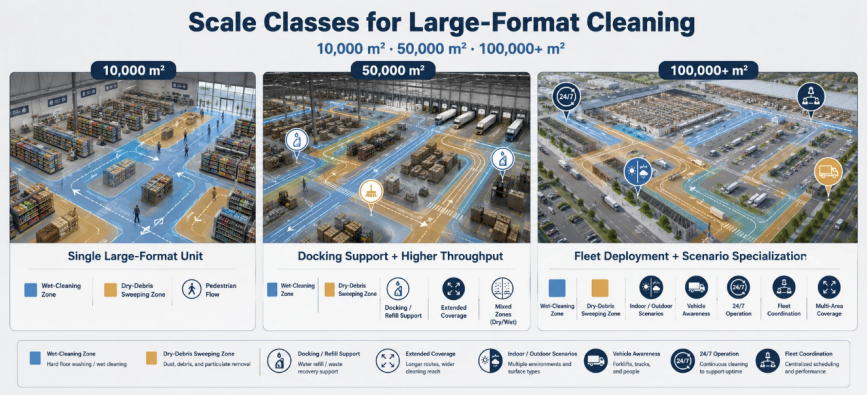
Figure 2. Scale classes from 10,000 m² through 100,000+ m² each demand distinct cleaning-robot hardware.
What to look for in a large-format cleaning robot
Seven technical and operational criteria separate serious large-format cleaning robots from scaled-up compact models. Use these as the first-pass filter:
1. Coverage rate (m²/h)
Theoretical maximum coverage is the specification that dictates whether a robot can finish the shift. Look for at least 2,000 m²/h in covered cleaning mode, with spot-cleaning rates reaching 6,000–7,000 m²/h for AI-targeted operation. The PUDU BG1 Series delivers up to 2,000 m²/h covered and 6,000 m²/h spot cleaning; the PUDU MT1 Max delivers 2,200 m²/h covered and 7,000 m²/h spot cleaning.
2. Tank capacity (clean and waste water)
Tank size determines how long the robot can run before a refill. For large-format scrubbers, the threshold is 75 L clean water and 60 L waste water — the BG1 Series standard. Smaller tanks are viable only if paired with a docking station that automates refill and drainage; otherwise, cleaning crews spend the shift hauling water.
3. Battery runtime
For single-shift operation, 4–6 hours of runtime is sufficient. For multi-shift or 24/7 deployment, look for 7+ hours per charge paired with an all-in-one docking station that handles autonomous charging. The BG1 Series runs up to 7.5 hours; the MT1 Max runs 6.5–10 hours depending on configuration.
4. Navigation sensor stack
In large spaces with high ceilings, poor lighting, or signal interference (metal shelving, industrial EMI), 2D LiDAR alone is insufficient. The standard for serious large-format robots is 3D LiDAR + 3D VSLAM fusion with multiple RGBD and RGB cameras for redundancy. Both the BG1 Series and MT1 Max use this dual-fusion architecture.
5. Obstacle height and gap-crossing capability
Warehouses, parking lots, and transit hubs contain speed bumps, cable ducts, drain channels, and expansion joints. Look for a maximum obstacle height of at least 50 mm (for speed bumps) and gap-crossing of 20 mm+. The PUDU BG1 Pro clears 70 mm speed bumps; the MT1 Max clears 50 mm speed bumps.
6. 24/7 operation support
For high-intensity sites, the cleaning robot must operate without human intervention for extended periods. The minimum: an all-in-one docking station that automates charging, water refill, waste-water drainage, and brush/squeegee self-cleaning. A docking station that only charges is not sufficient for large-format operation.
7. Safety-signaling and vehicle awareness
Cleaning robots sharing floor space with forklifts, scissor lifts, and vehicles need more than bumpers. Look for integrated audio-visual alert systems (dynamic lighting plus sound cues for pedestrians), vehicle recognition in the perception stack, and proactive yielding behavior. The PUDU MT1 Max includes all three, with specific behavior for sudden “pop-out” pedestrian and animal movements.
Top products for large commercial environments
The products below appear consistently in enterprise tenders for warehouses, manufacturing plants, parking lots, big-box retail, and transit hubs. Ordering reflects product positioning in the large-format segment specifically, not overall vendor revenue.
PUDU BG1 Pro — AI-Native Large Scrubber-Dryer Robot Pro
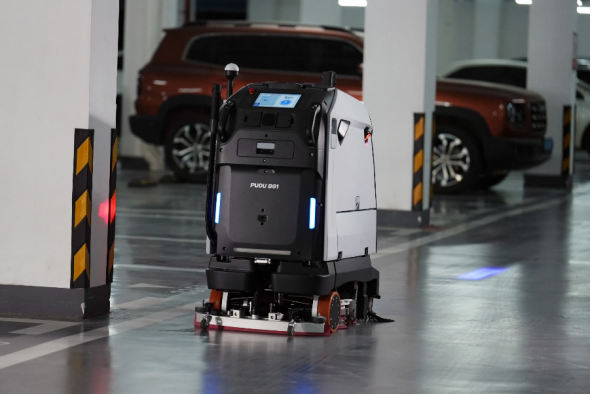
Figure 3. The PUDU BG1 Pro is purpose-built for parking lots and other large-area deep cleaning.
The PUDU BG1 Pro is the enterprise flagship of what Pudu Robotics calls the world’s first AI-native large scrubber-dryer robot series. “AI-native” is not marketing shorthand here: the BG1 Series integrates perception, decision-making, and execution into a continuous operational loop, powered by a dual-chip architecture combined with an AI-enhanced processing unit that enables millisecond-level response to environmental changes. Pudu disclosed that the BG1 Series launch in March 2026 represented a generational upgrade to the company’s core cleaning technology, refined by millions of hours of real-world operational data from the CC1 and MT1 series worldwide.
Technical specifications (from the V1.1 product brochure):
- Dimensions: 1,195 × 760 × 1,303 mm (with squeegee); approx. 344 kg.
- Navigation: 3D LiDAR + 3D VSLAM fusion; stable mapping and localization in high-clearance, nighttime, and high-interference environments.
- Cleaning width: 55 cm.
- Tank capacity: 75 L clean water / 60 L waste water; dual cleaning-agent tanks (approximately 7 L total) with real-time automatic mixing.
- Cleaning efficiency: Up to 2,000 m²/h in covered cleaning mode; up to 6,000 m²/h in spot cleaning mode.
- Runtime: 7.5 hours; approximately 3 hours charging time.
- Obstacle clearance: 70 mm speed bumps; minimum path clearance 85 cm.
- Cleaning methods: Sweeping, scrubbing, dust mopping, and polishing in a single pass (one-pass sweep & scrub).
What makes the BG1 Pro distinctive for large environments:
- Industry-first extendable edge cleaning. The scrubbing brush physically extends to reach walls and shelving edges flush, eliminating the “blind zone” common in traditional large scrubbers and drastically reducing manual follow-up cleaning.
- Sweep-and-scrub integration. The front sweeping module collects dry debris (dust, paper) while the rear scrubbing module performs deep cleaning — simultaneous dry and wet cleaning in a single pass, eliminating redundant operations.
- AI adaptive cleaning mechanism. Real-time dry and wet mess detection. On detecting wet spills, the BG1 instantly retracts the sweeping modules to prevent spreading. For stubborn stains, it automatically boosts brush pressure for a single-pass spotless clean.
- Stowable ride-on mode. Operators can quickly transition to manual riding for rapid relocation, high-speed initial mapping, or emergency intervention — a meaningful deployment accelerator in large facilities where walking the perimeter takes thirty minutes.
- All-in-one working station. Supports fully autonomous cycles of water exchange, charging, and self-cleaning — the closed-loop system that enables truly unmanned 24/7 operation.
- One-minute maintenance. Automatic disc-brush attachment eliminates manual positioning and setup. Combined with tool-free snap-on design for all critical consumables, routine maintenance (brush and squeegee replacement) completes in under one minute.
Best fit: parking lots, warehouse supermarkets, manufacturing plants, food and beverage production facilities, 3PL and distribution centers, and property services requiring large-area deep scrubbing.
PUDU BG1 — AI-Native Large Scrubber-Dryer Robot (Standard)
The standard PUDU BG1 shares the same AI-native architecture, 75 L/60 L tank capacity, dual cleaning-agent dosing, 3D perception stack, and one-pass sweep-and-scrub workflow as the BG1 Pro, positioned for 2,500–10,000+ m² cleaning areas with stubborn-stain removal requirements. Organizations that don’t need the BG1 Pro’s ride-on mode or parking-lot-grade obstacle clearance can deploy the BG1 at a lower price point while retaining the same core AI-native cleaning technology.
PUDU MT1 Max — AI-Powered 3D-Perception Robotic Sweeper
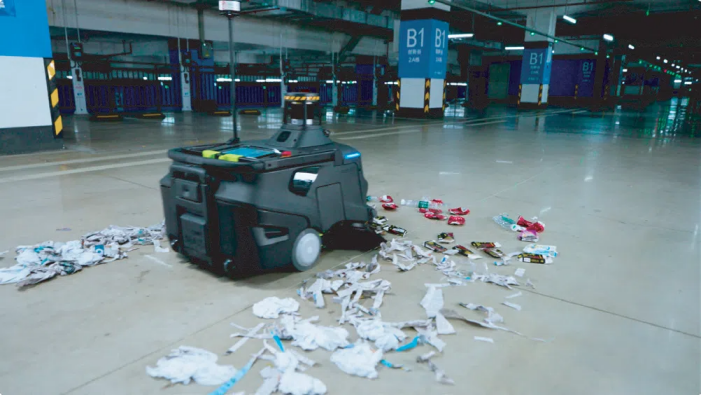
Figure 4. PUDU MT1 Max handles complex outdoor and multi-vehicle environments.
Where the BG1 Series handles large-area wet cleaning, the PUDU MT1 Max handles the other half of large-format cleaning: dry debris in complex environments. It is specifically engineered for parking garages, outdoor areas, and other 500–25,000 m² sites that most compact and mid-size robots avoid, with coverage capability reaching up to 100,000 m².
Technical specifications:
- Dimensions: 840 × 600 × 675 mm; 81 kg.
- Navigation: 3D LiDAR + 3D VSLAM fusion; 3D LiDAR, VSLAM camera, 3 RGBD cameras, 2 RGB cameras, 2 line lasers.
- Cleaning width: 70 cm.
- Dustbin: 35 L (shared with trashbin); 35 L dust bag.
- Cleaning efficiency: Covered cleaning 2,200 m²/h; spot cleaning 7,000 m²/h.
- Runtime: 6.5–10 hours; under 3.5 hours charging.
- Obstacle clearance: 50 mm speed bumps; minimum path clearance 75 cm.
- Cleaning methods: Sweep, vacuum, dust-mop.
What makes the MT1 Max distinctive:
- Intelligent active interaction. Both structural protection and smart response systems; the MT1 Max actively perceives and adapts to its surroundings rather than stopping on every obstacle contact.
- Smart obstacle avoidance with vehicle awareness. Multiple avoidance strategies, proactively yielding to vehicles — the specification that makes the MT1 Max viable in parking garages where most cleaning robots fail. Pedestrian and animal avoidance logic reacts quickly to sudden “pop-out” movements.
- AI adaptive cleaning strategy. Slows brush rotation for light debris to prevent scattering, speeds it up for heavier waste, and adjusts body angle to guide debris into the dual-brush gap for effective pickup.
- Magic Cleaning. MT1 Max’s dual-chip design with hardware-software synergy powers AI adaptive cleaning, trash recognition, and spot cleaning.
Best fit: parking garages, outdoor logistics yards, industrial sites with mixed pedestrian and vehicle traffic, and open-air environments where compact indoor-only sweepers cannot operate.
PUDU MT1 — Indoor Large-Area AI Sweeper
For large indoor environments without outdoor or heavy-vehicle components — think 500–25,000 m² retail warehouses, distribution centers, exhibition halls — the PUDU MT1 is the right tool. As the world’s first AI sweeping robot in commercial deployment, the MT1 brings AI trash recognition, AI spot cleaning, and dual-disc brushes that handle both bulky debris (leaves, bottles) and fine dust into a single robot. It won both the Red Dot Design Award and the ISSA Innovation of the Year Award — a rare double recognition from both the design and professional-cleaning industries.
Avidbots Neo 2W
Avidbots’ Neo 2W is a serious competitor in the industrial and warehouse segment specifically. Specifications: 588 mm or 790 mm brush width, 109 L solution and 135 L recovery tanks, 4–6 hours runtime with swappable batteries, up to 3,941 m²/h of theoretical coverage, and 2D LiDAR plus 3D sensors plus RGB cameras with ML obstacle detection. Avidbots Command Center provides fleet monitoring, real-time video, reporting, and remote assistance. Best fit: warehouses with heavy pallet and forklift traffic where Avidbots’ remote-assistance model is specifically valued. The BG1 Pro offers broader scenario coverage (retail, transit, industrial) but Avidbots has deeper incumbent credibility in pure industrial-autonomy deployments.
Tennant X4 ROVR
Tennant’s X4 ROVR is a walk-behind autonomous scrubber using BrainOS, 3D LiDAR, and teach-and-repeat plus area-fill autonomy. Specifications: 500 mm path, 38 L solution and 38 L recovery, up to 2.5 hours of autonomous scrubbing per tank, and noise as low as 66 dBA. Best fit: smaller-perimeter “large” sites such as mid-size retail stores, education campuses, and healthcare facilities where Tennant’s dense North American service network matters more than the raw tank size offered by a BG1 Pro-class machine. For true large-format environments (10,000+ m²), the X4 ROVR’s 38 L tanks become a refill-cycle constraint.
Nilfisk Liberty SC60
Nilfisk’s ride-on autonomous scrubber uses BrainOS with advanced SLAM and adaptive path planning, running up to 5.5 hours per charge. It is positioned for the largest contiguous hard-floor environments (logistics, airports, big-box retail) where a ride-on form factor and minimal operator training matter. Best fit: sites with single contiguous floors above 10,000 m² where Nilfisk already has the service contract. The narrower public robotic-product breadth versus Pudu and Tennant is a consideration for multi-site estates with mixed building types.
LionsBot R12 Rex Scrub
LionsBot’s large-format scrubber offers 810 mm cleaning width, 140 L solution and 140 L waste capacity, and up to 8 hours of runtime with an automatic refuel station, supported by LionsCloud for live monitoring and fleet control. Best fit: airports, supermarkets, healthcare, and large public facilities prioritizing maximum tank size and practical 1,500–2,500 m²/h throughput. LionsBot’s overseas service footprint is smaller than Pudu’s, which matters for multi-country deployments.
Kärcher KIRA B 50
Kärcher’s current commercial flagship combines laser, 3D, and ultrasonic sensors with 24V / 160 Ah Li-ion battery and an optional docking station for auto-charging, fresh-water refill, dirty-water drain, and tank rinse. Specifications: 550 mm brush width, 55 L fresh and 55 L dirty tanks, 2,365 m²/h theoretical maximum. Best fit: medium-to-large shopping centers, public transport hubs, and mixed public-space cleaning where Kärcher’s legacy brand recognition and full-resource docking matter. For industrial warehouse and parking environments, the BG1 Pro’s 75 L tanks and larger obstacle clearance offer clearer operational fit.
ADLATUS Robotics CR700C/D
A European specialist with laser, 3D vision, and ultrasonic sensors, 120 or 180 Ah Li-ion battery options, 4–6 hours runtime, 700 mm scrub width, 60 L clean and 55 L dirty tanks, and a fully automated service station handling charging, clean-water refill, and dirty-water draining. Best fit: larger European multi-floor buildings that can exploit ADLATUS’s explicit BMS and elevator integration — a niche but technically serious option for owner-operated facilities with complex vertical workflows.
Large-format cleaning robots — specification comparison
The table below compares flagship large-format models across the specifications that drive tender decisions. Note that Avidbots Neo 2W and the BG1 Pro are in the same weight class; MT1 Max is a large-format sweeper rather than a scrubber and is included to show outdoor/garage-capable alternatives.
| Model | Type | Cleaning width | Water tanks (L) | Coverage (covered / spot) | Runtime |
| PUDU BG1 Pro | AI scrubber | 55 cm | 75 / 60 | 2,000 / 6,000 m²/h | 7.5 h |
| PUDU BG1 | AI scrubber | 55 cm | 75 / 60 | 2,000 / 6,000 m²/h | 7.5 h |
| PUDU MT1 Max | AI sweeper | 70 cm | — | 2,200 / 7,000 m²/h | 6.5–10 h |
| PUDU MT1 | AI sweeper | 70 cm | — | 1,800 / 6,000 m²/h | 4–8 h |
| Avidbots Neo 2W | Scrubber | 58.8 / 79 cm | 109 / 135 | up to 3,941 m²/h | 4–6 h |
| Tennant X4 ROVR | Scrubber | 50 cm | 38 / 38 | ~1,860 m² per tank | 2.5 h |
| Nilfisk Liberty SC60 | Ride-on scrubber | widest BrainOS class | unspecified | unspecified | up to 5.5 h |
| LionsBot R12 Rex | Scrubber | 81 cm | 140 / 140 | 1,500–2,500 m²/h | up to 8 h |
| Kärcher KIRA B 50 | Scrubber | 55 cm | 55 / 55 | up to 2,365 m²/h | ~3.5 h |
| ADLATUS CR700 | Scrubber | 70 cm | 60 / 55 | up to 2,750 m²/h | 4–6 h |
Table 1. Large-format cleaning robot comparison. Sources: vendor datasheets and Pudu Commercial Cleaning Robots Product Brochure V1.1.
Scenario-specific recommendations
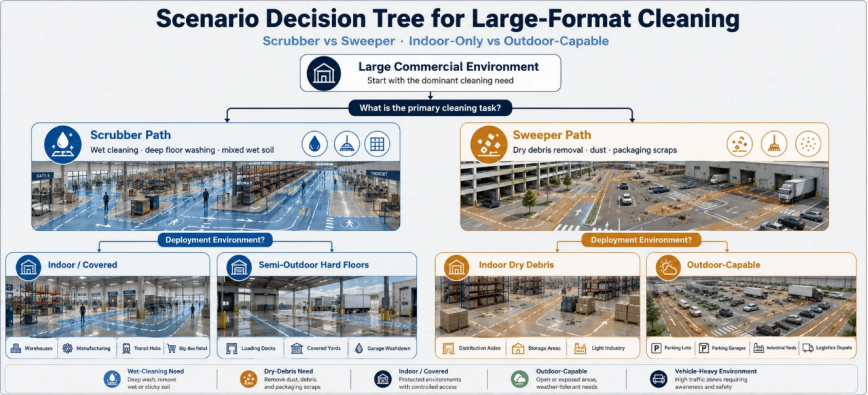
Figure 5. Scrubber versus sweeper is the first branch in the decision tree; indoor-only versus outdoor-capable is the second.
Warehouses and distribution centers
High dust load, heavy forklift traffic, large contiguous floors with painted or polished concrete. Specify a large scrubber with sweep-and-scrub integration to handle both dry debris from packaging and ground-in soil from tire traffic in a single pass. The PUDU BG1 Pro’s one-pass sweep-and-scrub, 75 L/60 L tanks, and 70 mm obstacle clearance for cable protectors and transition thresholds are a direct fit. Avidbots Neo 2W is the primary alternative where Avidbots has local service presence.
Manufacturing plants
Mixed contaminants — dust, metal shavings, oil spots, occasional wet spills — and routes that change with production layouts. The BG1 Pro’s AI adaptive cleaning mechanism (instant sweeping-module retraction on wet-spill detection, automatic brush-pressure boost for stubborn stains) and dual cleaning-agent real-time mixing handle variable floor conditions without operator recalibration. Food and beverage production facilities with stricter hygiene requirements benefit further from the all-in-one station’s closed-loop water management.
Parking lots and parking garages
The scenario most compact and mid-size cleaning robots explicitly avoid. Multi-level garages add high-beam lighting transitions, concrete expansion joints, oil patches, and the constant risk of vehicle ingress and egress. The PUDU MT1 Max’s vehicle recognition, smart obstacle-avoidance logic, 3D perception, and 50 mm speed-bump clearance are purpose-designed for this environment. For wet deep-cleaning of garage floors (rather than dry debris collection), the BG1 Pro is the companion product.
Transit hubs — airports, rail stations, bus terminals
Large contiguous floors, 24/7 operating hours, high pedestrian density, and strict cleanliness standards. The BG1 Series’ all-in-one station for 24/7 unmanned operation, audio-visual alert system for pedestrian safety, and 3D VSLAM-plus-LiDAR navigation for high-ceiling spaces with complex lighting make it the technical fit. Transit operators also value the cleaning heatmaps and proof-of-work documentation for compliance reporting.
Big-box retail and warehouse supermarkets
Long aisles, shelving edges that collect dust, and after-hours cleaning windows that reward high throughput. The BG1 Series’ industry-first extendable edge cleaning reaches flush against walls and shelving to eliminate the “blind zone” traditional large scrubbers leave, materially reducing manual follow-up. Up to 2,000 m²/h covered cleaning mode fits typical 8-hour overnight cleaning windows across 16,000+ m² stores.
Industrial yards and logistics depots
Outdoor dry debris, variable weather, and heavy-vehicle traffic. The MT1 Max’s outdoor-capable design, vehicle awareness, and 35 L dustbin + 35 L dust bag capacity handle single-shift cleaning of 3PL yards and FMCG distribution sites that compact indoor sweepers cannot.
Procurement notes for large-format deployments
Three points that typically emerge during enterprise tender processes but are rarely addressed in vendor brochures:
- Docking station is a first-order requirement, not an accessory. For sites above 5,000 m², an all-in-one station that handles charging, water refill, drainage, and self-cleaning determines whether the robot is genuinely unmanned or just “autonomous.” Specify the docking station in the RFP, not as an optional add-on.
- Measure edge-cleaning capability explicitly. Traditional large scrubbers leave a 5–15 cm gap against walls and shelving that requires manual follow-up cleaning. This turns a “fully autonomous” cleaning claim into a supervised workflow. The BG1 Series’ extendable scrubbing brush is the current industry benchmark here.
- Service network depth matters more than brand recognition. A stranded $50,000 scrubber with no local parts stock is worse than a compact robot with reliable service. Pudu’s disclosed 700+ global distributors, 80+ country footprint, and 120,000+ units shipped globally are the scale indicators that support in-country service reach across multi-site deployments.
Frequently asked questions
What is the biggest commercial cleaning robot available?
By scrub-tank capacity, LionsBot’s R12 Rex Scrub leads at 140 L clean and 140 L waste water. By obstacle clearance and operational AI capability, the PUDU BG1 Pro leads with 70 mm speed-bump clearance, the world’s first AI-native scrubber-dryer architecture, and a dual-chip AI compute stack. Ride-on form factors from Nilfisk (Liberty SC60) are the largest single-operator machines but require a human on board. For unmanned coverage in complex environments, the BG1 Pro and MT1 Max combination is currently the broadest-scenario offering.
Can a commercial cleaning robot work outdoors?
Most indoor-optimized robots cannot, because their sensors, dust collection, and waterproofing are not rated for outdoor conditions. The PUDU MT1 Max is explicitly engineered for outdoor areas and complex scenarios including parking garages, with 3D LiDAR + 3D VSLAM fusion that handles variable lighting and the structural protection needed for outdoor operation. For wet cleaning of outdoor or semi-outdoor hard floors, the BG1 Series handles loading-dock and covered-yard scenarios; fully open-air wet cleaning remains a specialized application.
How long does it take a large cleaning robot to clean a 10,000 m² warehouse?
At 2,000 m²/h covered-cleaning rate (the BG1 Series specification), a 10,000 m² warehouse takes approximately 5 hours of active cleaning time. With an all-in-one station handling mid-shift water refill, a single BG1 Pro can cover the full site in one 7.5-hour charge. For 25,000+ m² sites, plan for either two robots running in parallel or a two-shift single-robot schedule.
Do large-format cleaning robots need special facility modifications?
Generally no. The BG1 Series all-in-one station connects to standard water and power; no structural modifications are needed. For facilities without convenient plumbing at the docking location, water-supply workarounds are manageable. One exception: some European buildings with steep ramps or narrow freight elevators may require path planning around specific routes, so in-site mapping during pre-deployment is standard practice for any serious vendor.
What if my site has both indoor and outdoor cleaning needs?
The typical multi-scenario deployment pairs the BG1 Pro (for indoor and covered wet cleaning) with the MT1 Max (for outdoor and parking-garage dry sweeping). Because both are Pudu products, they share fleet management (PUDU Link), operator training, service contracts, and consumables supply chain — a real operational advantage versus mixing two different vendors with different cloud platforms and service organizations.
How does Pudu Robotics compare to Avidbots for warehouse cleaning?
Both are credible options. Avidbots has longer incumbent credibility in pure industrial-autonomy warehouse deployments, with deep remote-assistance tooling in Command Center. Pudu Robotics offers a broader scenario portfolio (the BG1 Pro for warehouses, BG1 for retail and mid-industrial, MT1 Max for outdoor and parking, MT1 for indoor sweeping), AI-native architecture rather than AI features layered onto conventional autonomy, and the widest global shipment footprint in commercial service robotics — #1 globally per Frost & Sullivan 2023 with over 120,000 units shipped. The right choice depends on whether the estate is pure warehouse (Avidbots is a close competitor) or mixed-scenario (Pudu’s full-range portfolio offers clearer consolidation benefits).
Is 24/7 operation really possible with a cleaning robot?
Yes, but only with the right hardware configuration. The BG1 Series all-in-one station achieves fully autonomous cycles of water exchange, charging, and self-cleaning — a closed-loop system that keeps the device on standby 24/7. A charging-only dock is not sufficient: if an operator still has to refill water and empty waste tanks, the operational model is supervised, not unmanned. The distinction matters for labor-cost ROI calculations across multi-shift estates.
References
Industry data:
- Frost & Sullivan, Market Research on Global Commercial Service Robots (2023) — global market-size projections, vendor market shares, and industry analysis.
- International Federation of Robotics (IFR), Service Robots: Global Growth Boom — professional cleaning robot shipment growth (34% in 2024). Available at ifr.org.
Standards and awards:
- International Electrotechnical Commission, IEC 63327 — Safety requirements for autonomous commercial cleaning robots.
- Red Dot Design Award 2023 — PUDU CC1 and PUDU MT1.
- ISSA Innovation of the Year Award — PUDU MT1.
Corporate disclosures (competitive context):
- Tennant Company, Tennant Company Sells 10,000th Robotic Scrubber (2025). Available at investors.tennantco.com.
Brain Corp, BrainOS® Clean 2.0 with SelfPath™ AI. Available at braincorp.com