
Interconnecting utility-scale solar generation and energy storage assets with local distribution networks demands rigorous adherence to regional power quality codes and dynamic grid support standards. Modern commercial infrastructure relies heavily on advanced solar hybrid inverters for industrial applications to reconcile variable renewable input with strict utility frequency and voltage limits. Understanding complex grid interconnection requirements allows facility engineers to streamline utility approval procedures while preventing operational disruptions on internal distribution buses.
Providing robust power electronics solutions, Enjoypowers specializes in manufacturing high-performance power conversion hardware engineered for demanding industrial environments. Leveraging strong internal R&D capabilities, flexible hardware customization, tested operational stability, and responsive global service support, the organization assists engineering teams with complex site integrations. Project managers, system integrators, and facility engineers are invited to contact technical specialists to receive tailored product specifications and discuss specific project requirements.
Multi-Mode Operational Topologies in Commercial Energy Systems
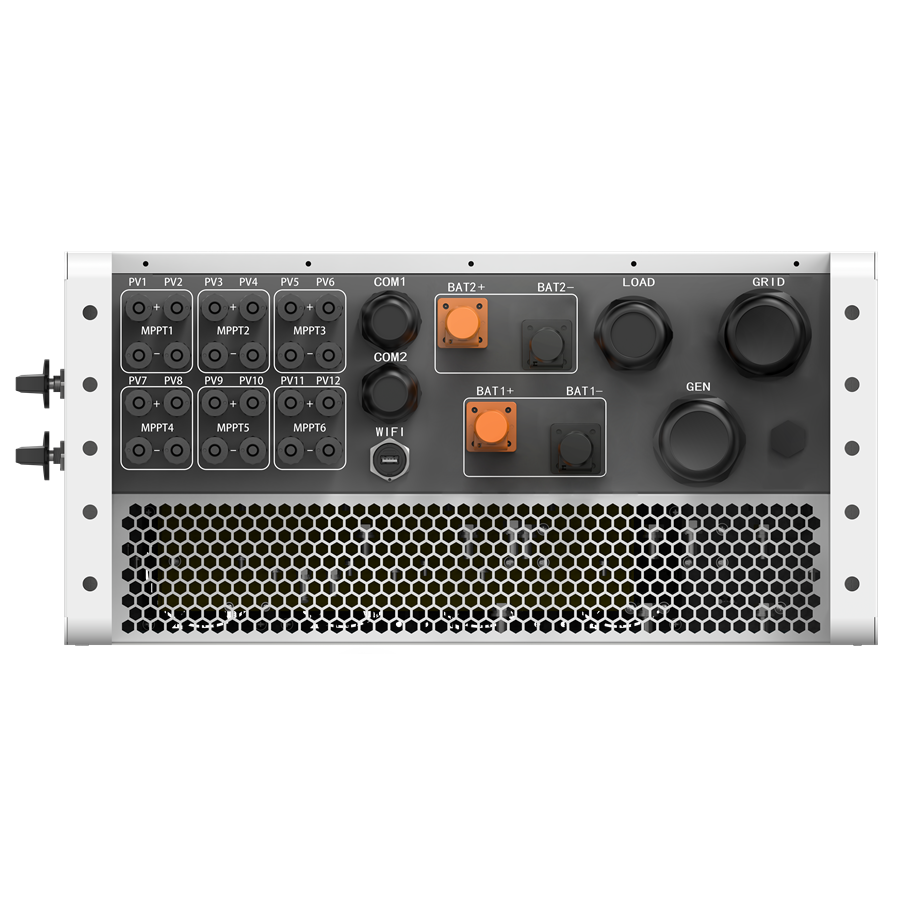
Integrating solar input, battery management, and multi-mode AC output into a single power module simplifies commercial facility architecture. The 40/50/60kW PV+Battery Hybrid Inverter delivers 60 kW continuous output inside an IP66 chassis suitable for outdoor wall or pad mounting, featuring six independent MPPT trackers that effectively manage complex commercial PV arrays.
Consolidating distinct functions within a single chassis eliminates the need for separate indoor inverter cabinets, battery converters, and external automatic transfer switches at this power level. Compact physical footprints reduce balance-of-plant installation space across commercial sites.
Dynamic Frequency and Voltage Support Mechanisms
Utility grid interconnection codes require modern conversion hardware to participate actively in feeder voltage and frequency regulation. During compatible grid disturbances, power conversion systems can provide active and reactive power support to help manage voltage and frequency conditions within the connected system.
Active frequency response algorithms adjust real power output dynamically to counteract rapid grid frequency drift. Suppressing line fluctuations supports regional grid stability and prevents unexpected system disconnects.
High-Speed Transfer Control and Uninterrupted Power Delivery
Utility disruptions present significant operational hazards to sensitive digital automation and IT infrastructure. Incorporating a shared control bus across PV input, battery management, and AC output stages within the 40/50/60kW PV+Battery Hybrid Inverter enables sub-10 ms grid/off-grid transfer speeds, keeping critical off-grid loads continuously energized within the ITIC curve tolerance for sensitive computing equipment.
Fast switching helps maintain power to critical loads during grid disconnections and can reduce the risk of interruption for sensitive industrial equipment. Commercial operations sustain continuous manufacturing output without experiencing costly line interruptions.
Converting Efficiency Benchmarks and Advanced Semiconductor Topologies
Maximizing daily energy harvest requires conversion hardware that maintains high efficiency across broad operating load ranges. Utilizing a three-level topology with optimized switching frequencies enables conversion efficiencies up to 98%, maintaining stable performance across the 30% to 100% load spectrum.
Higher operational efficiency reduces internal thermal dissipation and minimizes cooling demands within outdoor enclosures. Efficient power conversion accelerates overall project payback across multi-year asset lifespans.
Automated Energy Management Strategies in Industrial Applications
Commercial renewable facilities rely on automated dispatch routines to optimize financial returns against complex utility tariff structures. Engaging an established industrial hybrid inverter company helps plant engineers implement five core operating modes: self-consumption, peak shaving, time-of-use arbitrage, grid-tied/off-grid/hybrid modes, and generator support.
Automated Energy Management Systems coordinate PV generation, battery storage, utility supply, and backup generator priorities without manual intervention. Combining time-of-use tariff arbitrage with peak demand reduction significantly lowers monthly utility billing expenses.
Structural Endurance and Environmental Protection Standards
Deploying power conditioning equipment outdoors requires enclosures engineered to resist severe environmental degradation. Rugged IP66-rated enclosures shield sensitive power semiconductors from driving rain, airborne industrial dust, and thermal stress.
High power density combined with robust weatherproofing simplifies outdoor installation on commercial rooftops or ground pads. Reliable enclosure construction preserves internal component longevity across variable climate zones.
Interconnection Testing Protocols and Grid Anti-Islanding Protections
Utility approval procedures require rigorous factory and field testing to confirm anti-islanding protection compliance. Conversion hardware must detect utility loss instantly and disconnect from main feeder lines to protect line maintenance workers from backfeed hazards.
The hybrid inverter supports applicable grid-interconnection requirements and is designed for operation under multiple regional grid standards. Verified protection compliance simplifies regulatory approval with regional electricity distributors.
Selecting Power Conversion Hardware for Enterprise Facilities
Evaluating solar hybrid inverters for industrial applications requires analyzing MPPT voltage ranges, surge capacities, communication compatibility, and enclosure durability. Engineering teams assess total site load profiles to choose conversion hardware that aligns with prospective facility expansion plans.
The inverter supports Modbus RTU/TCP and CAN-based BMS communication, enabling integration with compatible battery management and site control systems. Standardized telemetry monitoring facilitates predictive maintenance workflows across commercial assets.
Conclusion
Navigating grid interconnection codes and utility compliance requires sophisticated power conversion technology equipped with fast multi-mode transfer, high conversion efficiency, and automated energy management capabilities. Enjoypowers‘ 40/50/60kW Hybrid Inverter integrates PV conversion, battery management, transfer switching, and EMS within an IP66 outdoor enclosure, with <10 ms grid/off-grid transfer and support for multiple regional grid-interconnection standards. Engineering procurement managers, utility planners, and project developers are encouraged to reach out to technical specialists to obtain detailed product documentation and request custom system proposals.