
A rodent treadmill is useful when a study needs controlled exercise, repeatable workload, or measurable endurance and motor performance. Yet choosing a system requires more than checking maximum speed.
Researchers need to consider the animal model, lane configuration, protocol flexibility, stimulation options, fatigue criteria, data outputs, and practical laboratory workflow. These factors shape how well the treadmill can support the study from conditioning through final analysis.
Start with the Research Objective
Exercise studies can have different objectives. Endurance experiments may require controlled running intensity and defined exhaustion criteria. Motor-injury studies may focus on repeated exercise and changes in performance.
Rehabilitation-oriented research can require graded workloads across sessions to track changes in motor function over time.
Because these aims generate different measurements, define the primary endpoint before comparing equipment. Consider whether the study needs distance, running time, speed, exhaustion state, or other recorded variables. A treadmill should provide the controls and outputs needed for those endpoints.
Match the Treadmill to the Animal Model
Mouse and rat studies do not necessarily need identical running spaces. Check lane dimensions, chamber height, belt configuration, and species compatibility before purchase. Multi-lane systems can also make group studies more practical, particularly when each animal needs an independently controlled running lane.
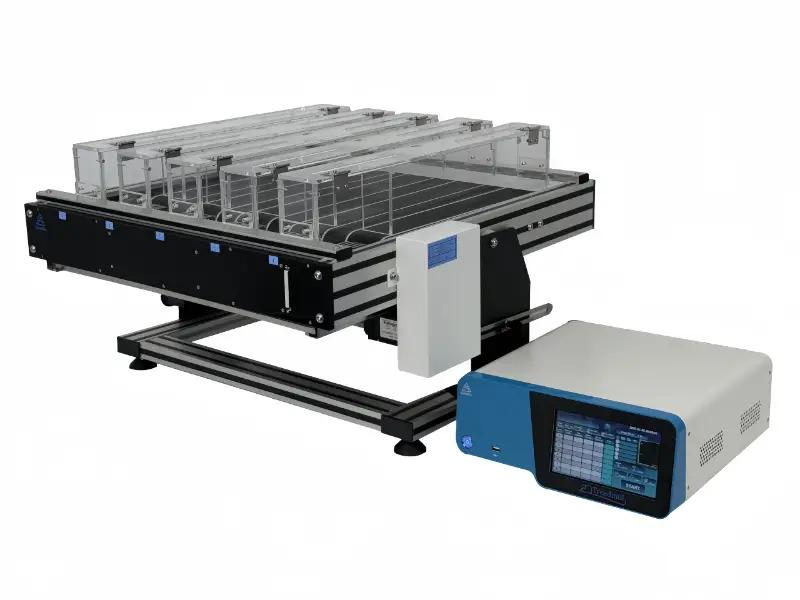
The SA101 Pro rodent treadmill from BioMed Easy is offered in mouse and rat configurations. Its standard application is five rats or five mice, with separate lane control. The company also states that customized lane numbers are available, allowing researchers to adapt capacity to their experimental requirements.
Examine Speed and Protocol Control
Speed range is important, but how that speed can be controlled may matter just as much. Look for uniform speed, acceleration and deceleration modes, and the ability to divide a protocol into different speed sections. These functions can support progressive exercise designs as well as more structured endurance protocols.
The SA101 Pro provides an adjustable speed range of 0.1–100 m/min with 0.01 m/min resolution and acceleration of 0.1–100 m/min². It offers uniform speed, uniform acceleration, uniform deceleration, and mixed acceleration/deceleration modes. Lane slope is adjustable from -25° to 25°, adding another variable for protocol design.
Consider How Fatigue Is Defined
A fatigue study needs a clear operational definition of exhaustion. Depending on the protocol, researchers may define an endpoint by time, frequency-based events, or another prespecified criterion. The equipment should make that endpoint easy to configure and record consistently.
The SA101 Pro provides five exhaustion modes based on distance, time, and shock. Its recorded results include distance, running time, number of shocks, shock time, current, exhaustion state, and speed. These outputs can help researchers review the workload delivered during each session and organize subsequent analysis.
Review Stimulation and Animal Handling
Some treadmill protocols use aversive stimulation to encourage continued running. Before selecting a system, researchers should understand how stimulation is delivered, whether its intensity is adjustable, and how it can be incorporated into the protocol. Ethical review and institution-specific animal welfare requirements should guide the use of any aversive stimulus.
The SA101 Pro includes pulse electric, sound, and light stimulation, with adjustable pulse-electric stimulation listed at 0.1–10 mA and an optional air-puff stimulus. It also uses individual lanes and removable acrylic walls with an aluminum frame, supporting access for setup and cleaning.
Check Data Export and Lab Fit
A treadmill should also fit the laboratory’s data workflow. Researchers can compare onboard storage, export options, control interfaces, sound level, and physical dimensions before installation. These details become more important when several instruments operate in the same room or when protocols are repeated across cohorts.
Maintenance and cleaning should also be considered, especially for studies involving repeated sessions, different animals, or frequent changes between experimental groups. For rehabilitation studies, consistent setup across sessions can also make longitudinal comparisons easier to interpret.
The SA101 Pro operates as a standalone system through its 7-inch capacitive IPS LCD touchscreen. The manufacturer specifies data export by USB flash drive in CSV or Excel format, with onboard storage for more than 1,000 datasets. The listed sound level is below 60 dB(A).
Choose a System That Supports the Full Study
For exercise, fatigue, and rehabilitation research, selection should connect animal compatibility, workload control, stimulation, exhaustion criteria, and data handling. A suitable treadmill is one that fits the planned protocol without creating unnecessary gaps between training, testing, and analysis.
With roots in life science instrument development and manufacturing, BioMed Easy Technologies operates as a subsidiary of SANS Biotechnology. The company was founded in 2016 and has obtained CE and ISO9001 certifications, as well as support for more than 3,000 laboratories globally.
Its official portfolio is organized into Motor Coordination, Pain, Learning & Memory, Anxiety, Fear & Emotion, Reward & Addiction, Video Tracking, Physiology & Neurosurgery, and Animal Care. This range allows laboratories to examine related research needs across different stages of animal and neuroscience studies.
As a manufacturer with in-house R&D and manufacturing facilities, BioMed Easy provides technical support, training, and after-sales service. Explore the official Rat/Mouse Treadmill page to review configurations and specifications, then contact the team to discuss a setup for your exercise, fatigue, or rehabilitation research program.