
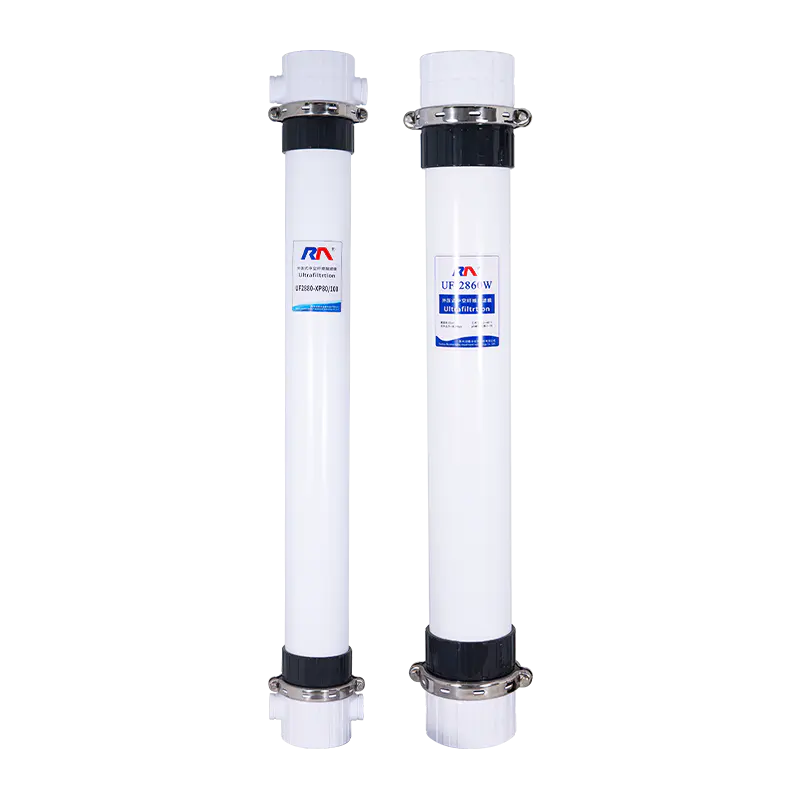
Water treatment systems need filtration technologies that can handle changing feed-water conditions while maintaining stable operation. Ultrafiltration is often used when a project needs to remove suspended solids, microorganisms, colloids, and other larger contaminants. Among the available membrane materials, PVDF is valued for its chemical stability and resistance to oxidation, making it relevant to demanding treatment and cleaning conditions.
What Is PVDF Ultrafiltration?
Polyvinylidene fluoride, commonly abbreviated as PVDF, is a fluoropolymer used in membrane manufacturing. In ultrafiltration, the membrane acts as a physical separation barrier that allows water and smaller species to pass while retaining particles, macromolecules, microorganisms, and colloids within its separation range.
The material itself is an important consideration because membrane systems need to be cleaned regularly to maintain stable water flux. Runmo states that PVDF has strong chemical stability, acid and alkali resistance, and significantly greater resistance to oxidants such as sodium hypochlorite than several other commonly used membrane materials. This characteristic is particularly relevant in systems where oxidant-based cleaning is part of routine operation.
Why Material Selection Matters
Membrane material can influence how a filtration system responds to cleaning, mechanical stress, and long-term operating conditions. A membrane that cannot tolerate its intended cleaning environment may require more careful maintenance or face a shorter operating life.
PVDF is widely considered a practical option when chemical resistance and mechanical durability are important. The product information also also highlights the flexibility and strength of its PVDF membrane fibers, along with improved fouling resistance achieved through hydrophilic modification. These characteristics are intended to support stable operation and easier maintenance in demanding water-treatment applications.
For project engineers, however, material selection should not be made independently from the rest of the system. Feed-water quality, treatment objectives, pretreatment, flux requirements, cleaning procedures, and operating conditions should all be evaluated together.
Common Uses in Water Treatment
Ultrafiltration can be applied to several industrial water-treatment processes because it provides fine physical separation without requiring the same operating principle as reverse osmosis. It can serve as a treatment stage for water containing suspended solids and microorganisms, or as pretreatment for downstream membrane processes.
Industrial users may encounter UF applications in sectors such as pure-water preparation, boiler feed-water treatment, food processing, and pharmaceutical manufacturing. These areas are listed among the applications for the PVDF ultrafiltration products.
The role of UF can vary from one project to another. In one system, it may be selected to improve the quality of water before a tighter separation process. In another, it may function as a primary membrane filtration stage. The correct configuration depends on the characteristics of the incoming water and the quality required at the outlet.
Product Features to Consider
When comparing a pvdf uf membrane for an industrial application, buyers should look beyond the membrane material itself. Flux, membrane area, module structure, connection specifications, operating conditions, and cleaning compatibility can all influence how the product fits a complete treatment system.
Runmo’s PVDF ultrafiltration range uses an outside-in configuration. The listed product series includes RM-UF-4046W, RM-UF-8060W, RM-UF-2660W, RM-UF-2860W, and RM-UF-2880W. Depending on the model, the membrane area listed by the manufacturer ranges from 6 m² to 75 m², while the design water yield at 0.1 MPa and 25°C ranges from 0.3 m³/h to 3.8 m³/h.
These specifications show why model selection needs to be matched to the actual project rather than based only on the general term “PVDF ultrafiltration.” A system requiring higher flow may need a larger membrane area, while a smaller installation may prioritize a more compact module.
How the PVDF Series Fits Different Projects
The pvdf uf membrane offered by Runmo is designed around several practical membrane requirements. According to the product information, the modules feature high oxidation and cleaning resistance, high flux, strong and flexible membrane fibers, improved fouling resistance, and a relatively small nominal aperture for removing suspended particles and microorganisms. The modules use an outside-in structure that is described as less prone to plugging, while the module design provides a relatively large filtration area.
For engineering companies and water-treatment businesses, these details can be useful when assessing whether a membrane is appropriate for an existing system or a new installation. Product dimensions, membrane area, water yield, shell material, inlet and outlet connections, and sealing configuration are all listed for the different models, making it possible to compare product options against equipment requirements.
What Buyers Should Evaluate Before Selection
Selection should begin with feed-water analysis and the required treatment performance, followed by checks on module specifications, cleaning compatibility, and operating conditions.
Commercial factors also deserve attention. Water-treatment engineering companies and system integrators should also consider project budget delivery requirements, and technical support alongside membrane specifications. A membrane that fits the system well can be more valuable than one selected simply because of a single headline specification.
Building a More Practical Filtration Strategy
PVDF ultrafiltration can be a useful option for water-treatment projects where chemical resistance, mechanical strength, and effective removal of suspended particles and microorganisms are important. The final selection should still be based on feed-water characteristics and the specific requirements of the treatment system.
With experience in membrane manufacturing, Runmo provides RO, UF, seawater, nanofiltration, and other membrane products for different water-treatment applications. Its PVDF ultrafiltration range includes multiple module options to accommodate varying system requirements.The available configurations can be evaluated according to specific treatment and system requirements.