
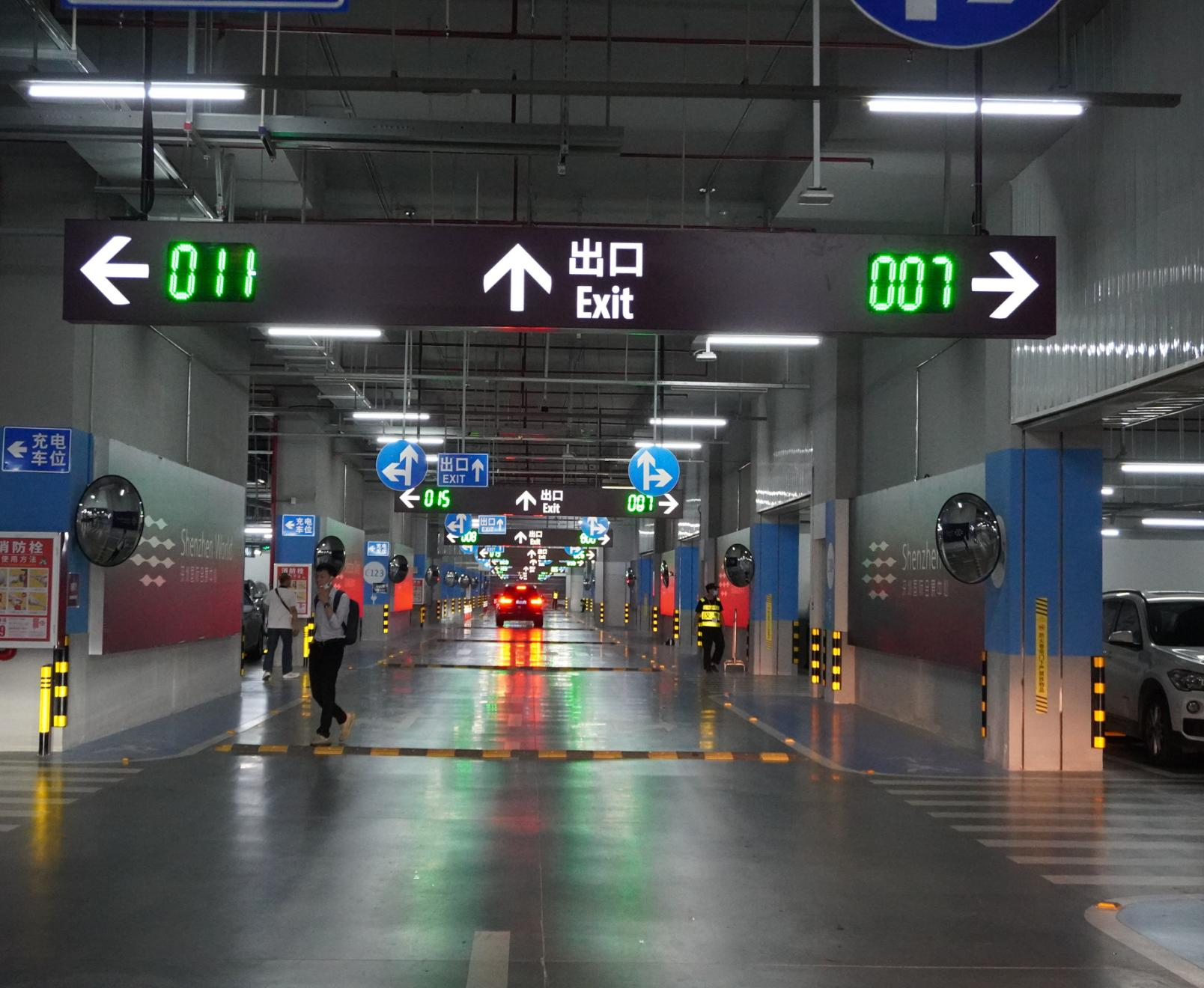
At a ramp inside a multilevel car park, capacity information must help a driver decide whether to change floors or follow directions toward usable spaces on the current level. Returning later creates another question: where is the vehicle? These decisions depend on connected records and displays. Parking automation combines occupancy readings, vehicle records, and location information to guide drivers through these different stages.
Guidance Begins with the Route
Entrances, ramps, intersections, and level changes divide the journey into decisions. A sitewide availability display answers a broad question before entry, but cannot identify the next useful turn inside. Floor and zone displays narrow the search, while aisle or bay indicators provide more local information as the vehicle approaches a parking position.
Within an automated parking lot management system, an entry record marks the visit, while guidance information describes the parking area. Those records serve different purposes. Knowing that a vehicle entered does not establish its eventual bay, and a vacant bay does not establish whether that arriving vehicle is authorized to use it.
Route mapping sets placement requirements for car park management system suppliers before displays are specified. Entrances, aisles, and exits need corresponding information levels, with each sign positioned to direct approaching vehicles toward the next ramp or junction rather than merely report a total.
From Occupied Bays to Available Capacity
A detector observes one space before that observation contributes to a larger count. An automated parking lot management system combines readings across defined floors or zones, then sends the relevant capacity to directional displays. Local occupancy and public availability remain distinct: a physically empty reserved space may still be unavailable to general visitors.
An inventory agreed with car park management system suppliers sets those counting boundaries. Charging areas, loading spaces, valet operations, and temporarily closed bays need explicit treatment rather than automatic inclusion in a public total. A usable figure represents the appropriate inventory and current readings; uncertain or unavailable data should not silently become an apparently free space.
As vehicles park or leave, changed readings alter the relevant zone count before guidance is refreshed. The operator should compare displayed availability with the defined inventory, especially after a closure or reservation changes which spaces belong in the public total.
Finding the Vehicle on the Return Journey
The returning driver needs location evidence rather than a vacant space. A search interface in an automated parking lot management system can use plate number, space, entry time, or a vehicle record without a plate. Entry records identify visits, while bay detection and floor maps contribute spatial information; occupancy alone cannot identify which vehicle belongs to a driver.
Search interfaces from car park management system suppliers must work with the records available at the site. Large venues can combine these sources with Bluetooth beacons where needed. The resulting search depends on actual vehicle and location associations, so beacon availability or precise positioning should not be assumed for every installation.
These connected clues appear in AKE Parking’s simulated indoor guidance area, which demonstrates vacancy updates, video bay detection, movement toward free spaces, and vehicle retrieval. Charging operations and designated new energy vehicle parking also appear in the demonstration, illustrating why general availability and special space categories need separate interpretation.
Following Records across System Boundaries
Departure brings access, payment, and parking records together without making them interchangeable. A departure record passes from its sender to the designated receiving platform; update confirmation is a separate responsibility within the automated parking lot management system interface. Interface responsibilities extend beyond equipment from car park management system suppliers to the site’s controller, cloud service, or existing management platform.
AKE Parking supports integration with existing devices, platforms, and third-party systems, with configuration reflecting the operating model. Implementation still needs agreed network segments, permitted protocols, synchronization, and power isolation. Installation documentation, remote setup assistance, and firmware updates support deployment; they do not remove the need to assign responsibility for each record exchange and its confirmation.
Keeping Guidance Trustworthy during Disruption
A sign can remain illuminated while its count becomes stale. A working screen does not prove that its automated parking lot management system is receiving current readings. Fallback planning therefore specifies unavailable data messages, manual marking of closed spaces, count corrections, authorized overrides, and which functions remain usable during an upstream interruption.
Handover documentation from car park management system suppliers should identify fault escalation and restoration checks. Commissioning should exercise normal arrivals and departures, reserved spaces, device faults, interrupted networks, and manual corrections. During restoration, drawings, configuration exports, device lists, and signed results connect the installed settings with recorded tests, providing a reference for checking recovered guidance.
After communication returns, restored displays should be checked against the actual parking inventory. Reconnecting a network alone does not verify corrected capacity. Operators need a consistent count and clear handover responsibilities before treating the recovered guidance as current again.
A Connected Journey through the Car Park
Across the journey, occupancy observations become counts, counts guide movement, and recorded location evidence supports retrieval. An automated parking lot management system depends on these connected exchanges; car park management system suppliers provide components and deployment support that connect them.
The driver’s final parking experience rests on reliably receiving current and useful information that matches the relevant spaces, routes, and vehicle records at every decision point.