
There is no useful answer to “Which material is best?” until the sleeping problem is named. A person who wakes hot may notice the cover and airflow first. Someone disturbed by a partner’s movement may care more about how the comfort layers and support core react to motion. A sleeper seeking firmer edge support has a different question again. Mattress choices improve when materials are evaluated against these needs instead of arranged into one universal ranking.
A thicker contouring layer may relieve pressure but feel slower to move across; an open surface may breathe well while offering little cushioning on its own. The comparison is between functions and trade-offs, followed by the way those functions are combined in a mattress.
For Heat and Moisture, Trace the Air Path
Temperature at the bed surface depends partly on room conditions, bedding, and the sleeper, so a mattress is only one factor. The cover and upper layers influence how air and moisture move near the body. A fabric with an open knit can provide paths for airflow, while foam shape may create channels beneath the cover. A thick, close-fitting comfort layer can change the sensation despite a breathable textile above it.
Suisin Furniture describes a knitted fabric with a micro-porous weave that supports airflow and moisture movement. Its convoluted wave foam creates ventilation channels and distributes surface pressure. Those descriptions provide examples of different mechanisms: one works at the cover, the other below it. A heat-sensitive sleeper would still need to assess the full construction, bedding, and room conditions rather than assume either material guarantees a cool night.
The best mattress material for this need is thus a combination that leaves an effective route for air and suits the desired feel. A cover label does not tell the whole story if the layer directly under it behaves differently. Comparing samples under similar room and bedding conditions provides more useful evidence than touching two fabrics for a moment.
For Pressure or Partner Movement, Examine Response
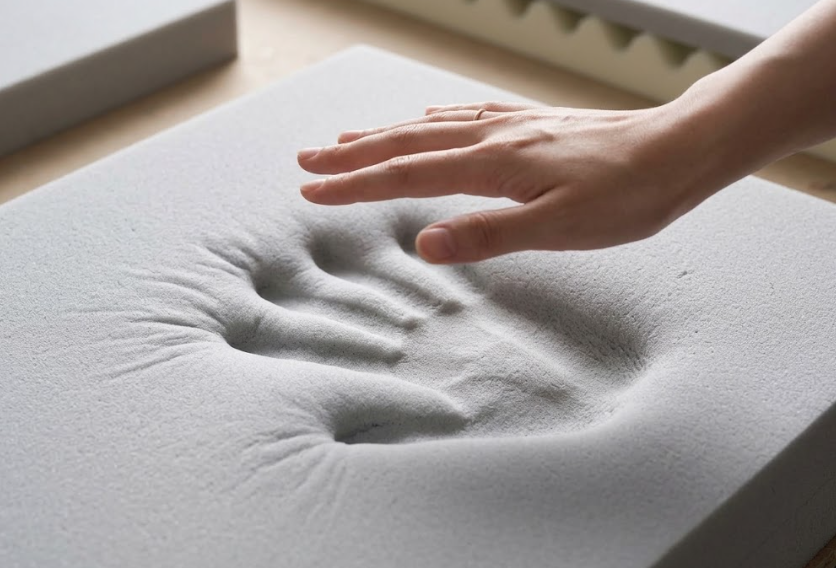
Pressure relief concerns how body weight is spread across the surface. A layer that conforms around shoulders and hips can reduce sharp contact points, but the support beneath it must prevent excessive sink. Slow-rebound memory foam conforms to body shape and can absorb some movement. Its feel may suit a person seeking contouring, while another sleeper may prefer a faster response when changing position.
Motion transfer is related but distinct. The question is how far a movement on one side travels across the bed. Foam can damp movement near the top, and pocket springs can respond more locally within the support core. Neither material works in isolation. Thickness, spring arrangement, cover tension, and the weight of the sleepers alter what is felt on the other side.
For mattress materials aimed at these needs, the company lists slow-rebound memory foam that contours around body curves and absorbs movement. Its wider mattress architecture includes high-density foam, polyfiber padding, and pocketed springs. These are building blocks for a product, not a promise of one fixed result. A sample should be judged for both the preferred pressure feel and the ease of turning or sitting up.
For Support and Edges, Look Below the Surface
Some sleepers focus on whether the mattress keeps the torso supported and the edge usable. Support is produced by the core and its interaction with the layers above. Pocketed springs can be arranged in ergonomic zones for shoulders, lumbar area, and hips. A foam layer changes how directly those zones are felt. A mattress that is firm at first touch can still support unevenly if the load path is poorly balanced.
Edges have their own loading pattern because people sit there and push down while leaving the bed. Reinforcement can reduce excessive compression at the perimeter. Suisin Furniture describes reinforced edge encasement and thermobonded hard cotton, a rigid layer that supports the upper construction and protects it from the spring unit. The edge system and protective layer serve different purposes; neither is captured by a general firmness score.
Size and use pattern matter too. A sleeper sharing a bed may value usable space near the edge, while a person with limited mobility may place more weight on a stable seated position. The right test looks at the relevant action on a sample, not only lying still in the center. Mattress materials have to be assessed in the posture and location where the need arises.
Combine Needs Before Choosing
Many sleepers need more than one function. Someone who sleeps hot and is disturbed by motion may need airflow near the surface and local movement control below. A hotel may seek a broadly acceptable combination that suits a broad range of users rather than a construction optimized for one preference. No single material name settles either decision.
Choosing the best mattress material starts with the primary problem, a secondary preference, and the compromises a sleeper can accept. The chosen mattress then has to show how its cover, comfort layers, support core, and edge treatment answer that particular combination. “Best” describes a fit between needs and construction, not a permanent winner among materials.