
A storage project may begin with a modest load and a limited battery budget, then expand as production lines, buildings, renewable generation, or backup requirements grow. Designing the full future capacity on day one can leave expensive equipment underused, while choosing a fixed architecture with no expansion path can make later growth disruptive.
A modular energy storage inverter addresses that planning problem by dividing conversion capacity into repeatable building blocks. For scalable energy storage, the engineering value lies in adding power without forcing the original DC architecture, cabinet layout, and control concept to be rebuilt from the beginning.
Capacity Growth Changes the Original Design Assumptions
The first installation is usually sized around the load profile and energy objective known at that time. A factory may add machinery, a commercial campus may expand, or a microgrid may increase photovoltaic and battery capacity after the initial phase proves successful.
Each change can increase required converter power and alter the balance among battery strings, DC buses, switchgear, cooling, and available floor area. A modular architecture gives the project a defined route for that growth.
Instead of treating future capacity as an entirely separate plant, additional conversion cabinets can be planned as extensions of the original system. With compatible electrical and control design, a modular energy storage inverter can reduce the equipment that must be replaced when demand grows.
DC Architecture Influences How Expansion Is Added
Expansion is easier when the DC side can accommodate more than one project arrangement. A single-bus design can simplify common battery connections, while multiple DC buses can support architectures that separate battery groups or project functions.
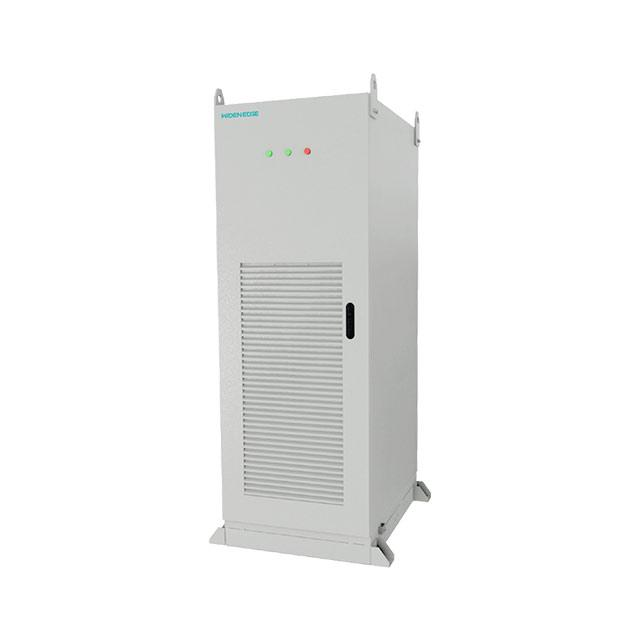
WidenEdge’s MGC 600kW supports both single-bus and multi-bus DC configurations, allowing the DC connection to follow the project’s battery grouping. A shared bus can simplify compatible battery connections, while multiple busbars accommodate more segmented layouts as capacity grows. This flexibility can reduce changes to the converter interface during expansion, provided the final current and protection requirements are verified.
Scalable energy storage involves more than adding AC power: battery capacity, DC current, protection zones, isolation, and maintenance can all change as cabinets are added. A modular converter platform is more practical when its DC options can follow the way the storage system itself is being expanded.
Physical Layout Can Become the Limiting Factor
Electrical capacity may be available on paper while the site has no room for another large standalone converter. Cabinet dimensions, door clearance, cable entry, ventilation, forklift paths, and service aisles all influence how much equipment can be installed.
A modular energy storage inverter can support staged deployment only if its mechanical arrangement remains workable as more capacity is added. The MGC 600kW uses a modular cabinet structure intended to optimize space utilization and permit rapid capacity expansion.
WidenEdge also describes intelligent cabinet-to-cabinet paralleling, front-and-rear double-door access, and side-by-side installation for higher power levels. Those features connect expansion planning with installation practice: cabinets have to communicate and operate together, but technicians also need physical access after the rows become denser.
Parallel Capacity Needs Coordinated Operation
Adding cabinets increases rated power only when the units can share the electrical duty correctly. Parallel systems need coordinated current or power contribution, compatible protection behavior, communication, and a control strategy that does not create circulating power or unstable interactions.
The expansion concept therefore belongs to both hardware and controls. Modularity can also support staged redundancy. A project may choose several cabinets so maintenance on one unit does not remove all conversion capacity, although the actual redundancy level depends on loading and system design.
Scalable energy storage can then be planned around increments of usable power rather than one monolithic block. That can suit C&I sites with limited shutdown windows and uncertain load growth.
Environmental and Service Design Matter During Expansion
More cabinets also mean more filters, cooling paths, electrical connections, and service points. For industrial environments, the MGC 600kW uses a dust-protection cabinet with integrated filters, an arrangement that remains relevant as additional cabinets enlarge the installed fleet.
Dust management does not create scalability by itself, but it affects whether a larger installed fleet remains maintainable as the project ages. Service access becomes increasingly important when several cabinets are installed side by side.
Front-and-rear double-door access can support maintenance planning where equipment density is high. The value of a modular energy storage inverter therefore extends beyond the moment a new cabinet is commissioned; the larger system still has to be inspected, cooled, protected, and serviced throughout its operating life.
Scaling Without Rebuilding the Whole Project
A scalable project needs a growth path that is visible in the first design. The initial phase has to reserve suitable switchgear capacity, communications, physical space, battery architecture, and control provisions for later additions.
Modularity cannot recover every project that was never planned to expand, but it can reduce the structural changes required when future phases were anticipated. The MGC 600kW brings configurable DC buses, modular cabinets, intelligent paralleling, side-by-side installation, dust protection, and service access together in WidenEdge’s large-scale storage platform.
Those characteristics make scalability a property of the architecture rather than a promise to add more kilowatts later. For C&I storage and microgrids, the practical advantage is the ability to grow conversion capacity in planned increments while preserving as much of the original electrical and mechanical design as possible.
SEO Title: How Modular Energy Storage Inverters Support Scalable C&I and Microgrid Projects | WidenEdge
Meta Description: Read our latest insights on How Modular Energy Storage Inverters Support Scalable C&I and Microgrid Projects. Explore expansion, layout, and coordination.