
Optimizing a facility’s infrastructure often begins overhead. For plant managers, facility directors, and supply chain executives, the choice of illumination directly impacts utility expenses, worker safety, and workplace productivity. Historically, heavy-duty environments relied on conventional high-intensity discharge lamps or heavy-duty fluorescents.
Many facility upgrades now focus on improving energy efficiency, maintenance, and lighting performance through modern LED systems. Selecting the right setup requires understanding the stark contrasts between legacy systems and contemporary options.
As operations scale and energy regulations become stricter, investing in advanced industrial lighting shifts from a routine maintenance task to a strategic business decision. This guide examines how legacy systems stack up against modern alternatives and what decision-makers should evaluate before initiating a facility-wide retrofit.
The True Cost of Legacy Alternatives
For decades, high-pressure sodium (HPS), metal halide (MH), and traditional fluorescent fixtures dominated large-scale factories, cold storage warehouses, and logistics centers. While these legacy technologies provided necessary illumination, they carried significant operational burdens.
High-pressure sodium lamps, recognizable by their distinct yellowish glow, offer long lifespans but suffer from poor color rendering. This limitation can hinder visual accuracy in critical quality control zones or detailed assembly lines where precise color differentiation is necessary.
Metal halide fixtures provide a whiter light suitable for manufacturing tasks but consume massive amounts of energy and experience rapid lumen depreciation. A metal halide lamp might lose a substantial portion of its brightness halfway through its rated life, requiring frequent replacements.
Furthermore, both HPS and MH lamps require prolonged warm-up and restrike times. After a power interruption, many HPS and metal halide systems require a warm-up or restrike period before returning to full output.
Fluorescent systems, while slightly more adaptable, often struggle in temperature extremes—particularly in cold storage or unconditioned warehouses—and contain hazardous materials that complicate disposal procedures.
Operational Efficiency Advantages of Solid-State Architecture
In contrast to outdated technologies, modern light-emitting diode architectures are engineered specifically to overcome the harsh demands of B2B environments. Upgrading to high-quality led industrial lighting solutions yields substantial reductions in electrical consumption, often cutting energy usage by more than half compared to high-intensity discharge counterparts.
This drastic reduction in utility draw accelerates the return on investment for large-scale retrofits across complex enterprise footprints.
Beyond direct energy savings, thermal management and durability play crucial roles in warehouse settings. Premium LED configurations generate significantly less ambient heat, which reduces the thermal load on a facility’s HVAC and refrigeration systems—a major consideration for cold chain logistics and food processing plants.
Moreover, solid-state fixtures contain no fragile glass envelopes or delicate filaments, making them highly resistant to vibrations caused by heavy machinery and forklifts.
A secondary advantage involves advanced optical control. Rather than emitting light omnidirectionally and relying on inefficient reflectors, modern luminaires direct illumination precisely where it is required. This targeted distribution improves light uniformity across warehouse aisles and manufacturing floors, enhancing worker safety while minimizing shadows.
Additionally, the instant-on capability of solid-state components supports seamless integration with smart controls, such as occupancy sensors and daylight harvesting systems, allowing facility managers to optimize energy usage without warm-up delays.
Key Specifications for High-Grade Retrofits
Not all contemporary lighting upgrades offer the same long-term value. For enterprise-level facility managers, selecting a system involves scrutinizing construction quality, modularity, and integration capabilities.
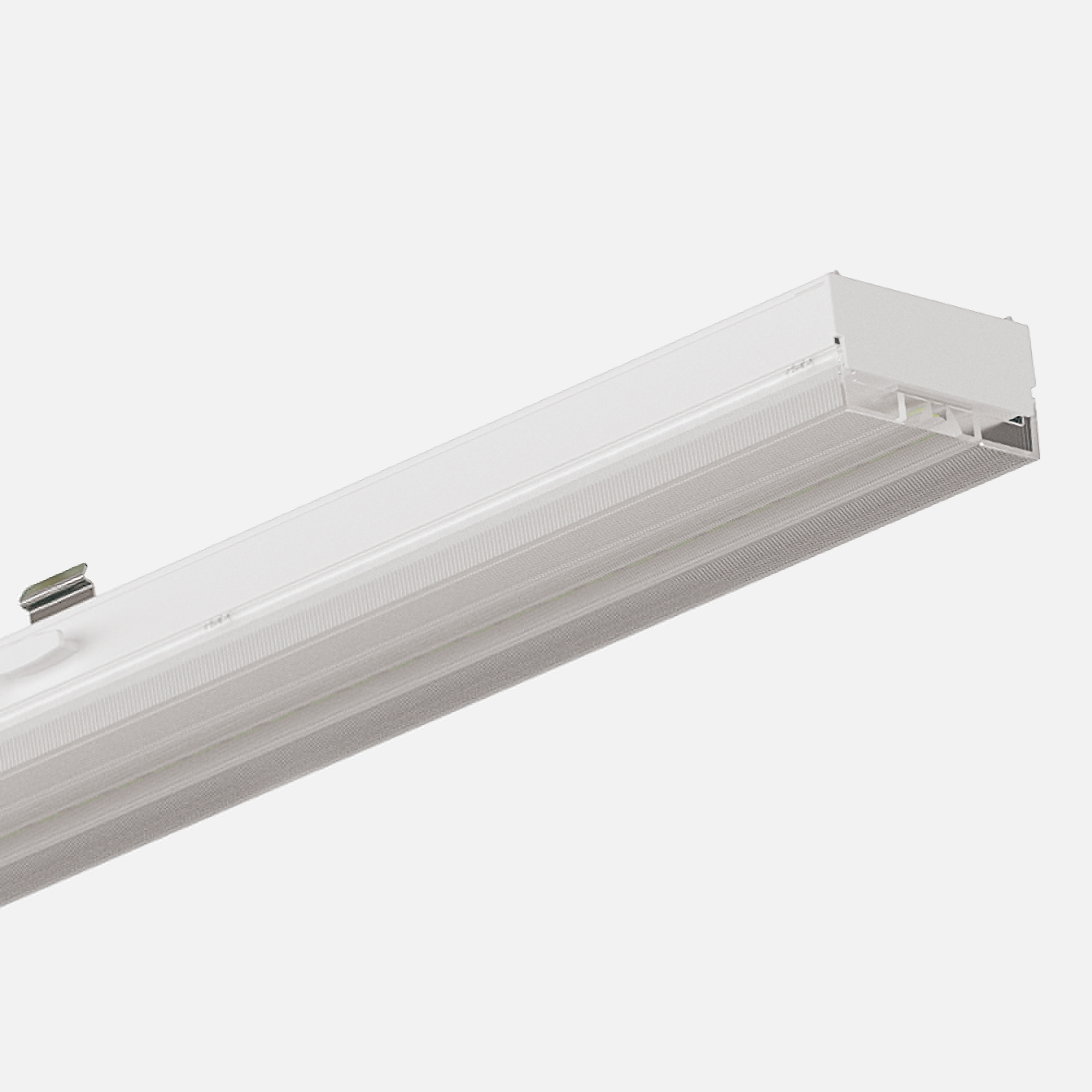
High-ceiling environments, such as distribution centers and heavy assembly plants, benefit tremendously from fixed-style trunking systems that allow for ultra-long cascading and high load capacities. These features simplify complex layouts while maintaining structural integrity across extensive ceiling spans.
Retrofitting existing infrastructure also requires versatile design. The most effective solutions offer universal retrofit modules compatible with mainstream European trunking rails, allowing businesses to reuse existing circuitry and lower installation downtime without compromising safety protocols.
For demanding spaces, features like robust ingress protection ratings—indicating resistance to dust, moisture, and impact—are essential.
Furthermore, a system’s readiness for IoT integration, such as built-in radar sensors or smart O&M capabilities, provides a foundation for future automated building management.
High-grade systems typically command premium pricing, but they offset initial capital expenditures through reduced maintenance cycles, lower inventory costs, and dependable performance across their extended lifespan.
The Impact of Choosing a Specialized Manufacturing Partner
Implementing a successful facility upgrade requires collaborating with a manufacturer that deeply understands the multifaceted complexities of commercial and heavy-duty environments. An export-oriented manufacturer such as TRIECO provides one example of this specialized approach.
Operating a sprawling 10,000-square-meter modern production zone equipped with automated roll-forming lines, SMT workshops, and an advanced laboratory built to CNAS certification standards, the company delivers turn-key professional retrofit solutions.
For enterprise clients, the availability of customized development is highly valuable. Whether outfitting an ultra-slim linear track system for a vast retail space or deploying intelligent tri-proof luminaires for basement environments, having a partner with robust R&D capabilities and complete European market certifications streamlines implementation.
Their focus on high-grade quality and strict adherence to ISO9001 and ISO14001 standards demonstrates that the fixtures are built to endure the rigors of heavy use while supporting corporate sustainability targets.
Strategic Infrastructure Investments for Future-Ready Facilities
Transitioning away from legacy illumination is far more than a routine facilities update; it represents a fundamental upgrade to a building’s operational infrastructure. By carefully comparing the inefficiencies of conventional high-intensity discharge and fluorescent lamps against the performance metrics of advanced solid-state systems, business leaders can make informed, data-driven choices.
Prioritizing premium, highly engineered fixtures backed by specialized manufacturers delivers reliable illumination, lowers long-term overhead, and creates safer, more productive environments for the workforce. Modernizing today builds a resilient foundation for the automated, energy-conscious industrial spaces of tomorrow.