
Evaluating a motion control robotics supplier requires looking beyond specification sheets. Technical parameters can be matched on paper, but real-world performance depends on engineering depth, design philosophy, and support infrastructure.
The question is not which supplier has the most impressive datasheet, but which one can deliver consistent performance across production volumes and operating conditions. Here is a practical framework for making that assessment.
Can the Supplier Solve Problems Beyond Standard Specifications?
Every supplier provides datasheets. Few can explain the engineering decisions behind the numbers. Moving from specification comparison to capability verification means asking harder questions.
Control algorithms reveal engineering depth. A supplier that has developed its own servo control software, rather than licensing a generic solution, demonstrates a different level of commitment.
Proprietary algorithms for current loop tuning, resonance suppression, and adaptive gain scheduling indicate genuine expertise in motion control for industrial robotics.
When a supplier can articulate how their torque control handles varying loads or how vibration suppression adapts to changing mechanical conditions, they are revealing genuine engineering capability rather than marketing fluency.
Product portfolio coherence is another useful test. A supplier offering a fragmented collection of rebranded components is fundamentally different from one with a unified product architecture.
Kinco has built a comprehensive system covering HMI, PLC, servo systems, stepper systems, and VFDs around a consistent technology platform. Coherence matters because it reduces integration risk when components must communicate and coordinate seamlessly.
Customization capability is the practical measure of engineering resources. Standard products serve standard applications. If your system requires modified mounting interfaces, communication protocols, or torque characteristics, can the supplier respond? Ask about past customization projects. The depth of their answers reveals the depth of their engineering bench. A supplier that hesitates or offers only standard options may lack the technical capacity to support unique requirements.
Does the Product Architecture Reduce System Integration Risk?
Product architecture is a telling indicator of how a supplier thinks about real-world system challenges. Two approaches dominate: discrete component architectures and integrated modular designs.
Discrete architectures use separate motors, drives, gearboxes, and wheels—each sourced and assembled during integration. This gives engineers more freedom to select individual components, but also creates more interfaces to manage. More wiring connections, more mounting alignments, more potential failure points. The flexibility comes with a cost in integration complexity.
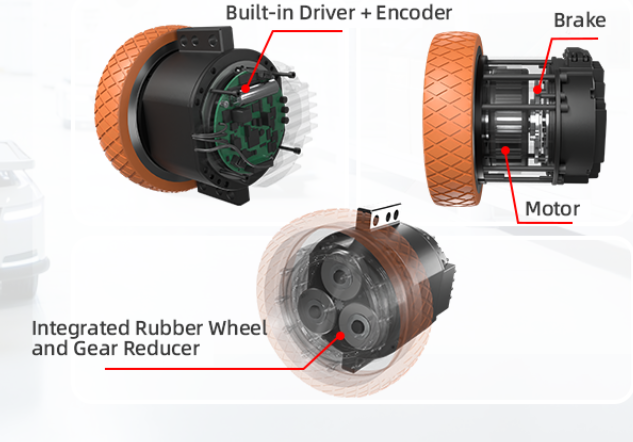
Integrated architectures combine multiple functions into single assemblies. The servo drive, motor, gearbox, and mechanical output are designed as a unified system rather than separate components.
This eliminates cabling between drive and motor, reduces mounting footprint, and simplifies the bill of materials. For applications where space is constrained and reliability is paramount, integration directly addresses the pain points of traditional separation. Kinco’s servo wheel modules are an example of this approach, integrating drive, motor, gearbox, and wheel in a compact assembly for mobile robotics.
The integration philosophy also appears in communication design. Suppliers that offer cascaded interfaces—one-to-many connections that simplify cabling and commissioning—demonstrate systems-level thinking. Motion control robotics systems rarely operate as single-axis devices.
Coordination across multiple axes is the norm. A supplier that designs for multi-axis coordination from the start will reduce your integration effort compared to one that treats each axis as an isolated component.
Communication protocol support is another practical test. Does the supplier offer EtherCAT, CANopen, Modbus, or proprietary solutions? Compatibility with your existing control architecture determines how smoothly integration proceeds. Suppliers that support multiple protocols with proven implementations can adapt to your system rather than forcing you to adapt to theirs.
What Evidence Shows the Products Will Work in Your Application?
Technical capability and thoughtful architecture are necessary but not sufficient. The critical question is whether the supplier has proven their solutions in applications similar to yours.
Case studies with measurable outcomes provide the most useful evidence. Look beyond vague statements of customer satisfaction. Seek specific metrics: positioning accuracy achieved, cycle time reduced, uptime maintained.
For AGV and AMR applications, evidence of payload handling across the range relevant to your project is essential. A supplier that can document deployments in logistics, warehousing, and material handling demonstrates practical experience that no datasheet can convey.
Attending industry exhibitions offers the chance to see products in operation. A live demonstration reveals far more than a specification sheet. Does the motion appear smooth? Does the system respond promptly to commands? Can the supplier’s engineers answer technical questions on the spot? These observations provide direct evidence of product maturity and engineering competence.
Testing procedures are another window into quality. How does the supplier validate performance before shipping? What environmental tests are conducted? Are motors and drives tested as matched pairs or as individual components? Suppliers with rigorous factory testing—including burn-in, temperature cycling, and load testing—are more likely to deliver products that perform reliably in the field. These questions are often more revealing than reviewing an ISO certificate.
What Happens After the Purchase Order Is Signed?
The relationship with a motion control supplier does not end at delivery. Support infrastructure determines long-term value.
Global certification is a practical starting point. CE and UL certifications indicate compliance with international safety and performance standards. Products with STO (Safe Torque Off) functions and dual-encoder configurations demonstrate attention to functional safety requirements. These are not optional for many automated systems and should be verified early.
Response time matters in production environments. What is the standard technical support response window? Is remote diagnostics available? What is the lead time for critical spare parts?
These operational details determine how quickly production resumes after an unexpected failure. A supplier that cannot answer these questions clearly may not have the infrastructure to support your operations.
Localized support for international customers is equally important. Suppliers that maintain overseas service teams and offer customized development aligned with regional industrial trends provide a level of partnership that pure component vendors cannot match. This is particularly relevant for multinational buyers who need consistent quality across multiple production sites.
Supply chain stability deserves attention as well. Does the supplier manufacture their own core components, or do they rely on third parties for critical parts? Vertical integration can reduce dependence on external suppliers and improve control over critical components. Suppliers with established production capacity and proven delivery performance are better positioned to maintain schedules even during market disruptions.
A reliable supplier proves more than product availability. Engineering capability, product architecture, testing processes, and after-sales support should all reduce risk for the buyer. Evaluating these factors before procurement is far more effective than discovering weaknesses after the system is already in production.
The right partner makes integration smoother, production more reliable, and troubleshooting faster—outcomes that appear on the bottom line, not just on a datasheet.